Patchlight Team·
Reviews every pull request and commit, and keeps a scheduled security monitor on your repositories. GitHub-native, pay only for what you use.
2-click install · no credit card · never trained on your code
acme/payments-apisecurity monitor · scanning
Findings7
- criticalCWE-89
Search filter concatenates q directly into SQL
src/api/users.ts:214
- highCWE-798
Live database password committed in plaintext
scripts/seed-db.ts:19
- mediumCWE-918
Issuer URL is fetched without host allow-listing
src/auth/oidc-discovery.ts:88
+ 4 more in the dashboard
0files walked0candidates sent0findingsevery 24h
Features
Eight things it runs today, in the order you meet them.
01
Security monitor
The whole repository, not just the diff
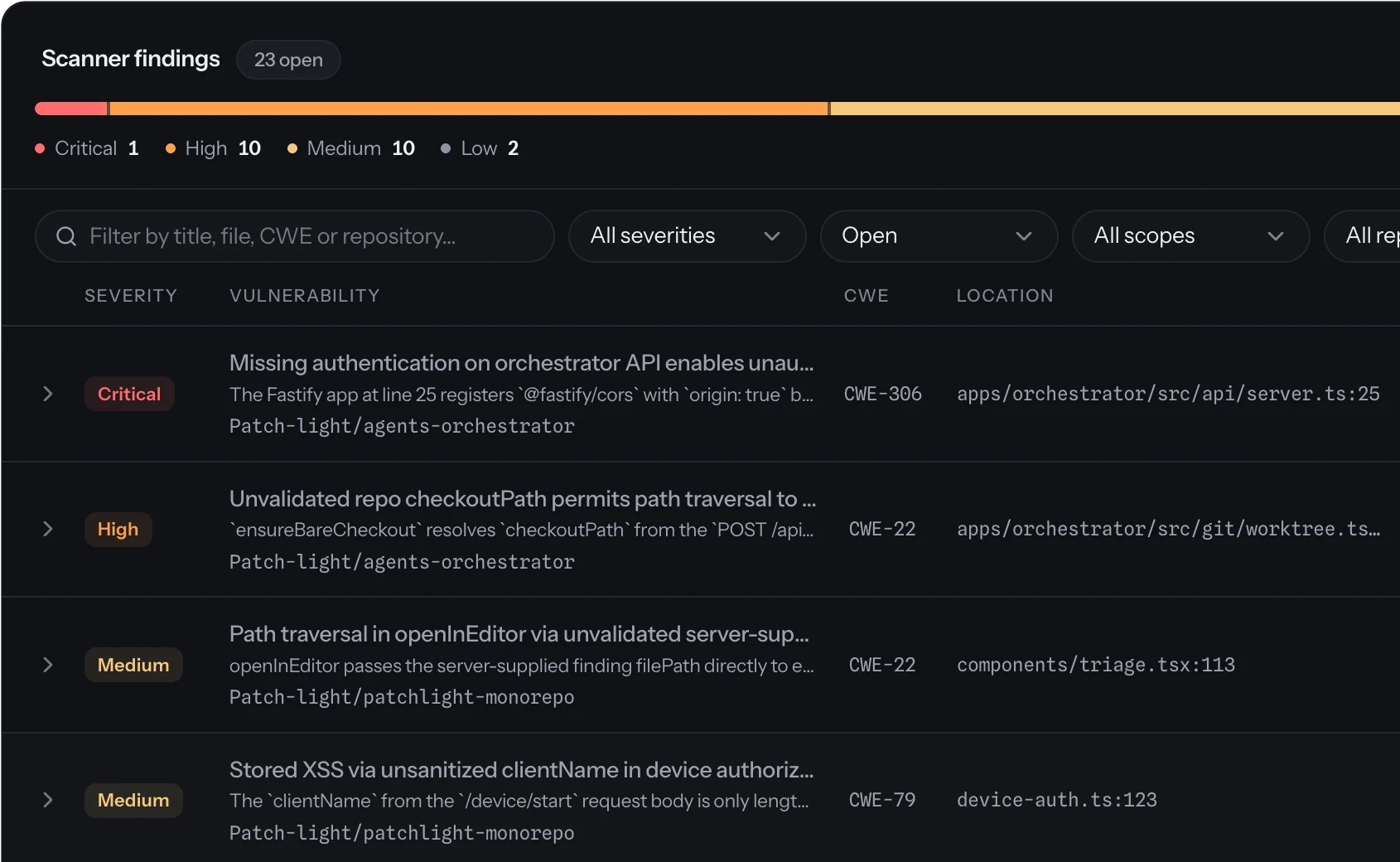
On a schedule or on demand, Patchlight walks every file in the repo, sends only what looks risky to the model, and reports findings it can point at: severity, CWE, exact file and line. They land in one triage table and stay there until they're resolved.
- Nightly scans per repository — you choose which ones
- Every finding carries a CWE and a file:line you can open
- Filter by severity, scope or repo; resolve as you fix
02
PR review
A senior reviewer on every pull request
Each pull request — and every push to it, if you want — is read for correctness, security and maintainability. Findings that come with a fix are posted as inline GitHub suggestions you can commit in one click; the rest go into a summary comment that opens with what the PR actually does.
- Suggestions anchored to the exact lines they fix, committable from the PR
- Severity and category on every finding: security, bug, performance, style, maintainability, convention
- Everything also lands in the dashboard, so nothing is lost when the PR closes
src/api/users.ts+12 −4
16export async function getUser(ctx, id) {
17 const user = await db.users.find(id);
17 const user = await requireOwner(ctx, id);
18 return serialize(user);
patchlightbotcommented on this line
🟠HIGH · security: Any caller can read any user by id
db.users.find(id) is not scoped to the requester, so a guessed id returns another tenant's record. Go through the ownership guard.
Suggested change
− const user = await db.users.find(id);
+ const user = await requireOwner(ctx, id);
Commit suggestionAdd to batch
03
Reverse task check
Did the PR do what the ticket asked?
After a merge, Patchlight finds the Linear issue behind the PR — from the branch name, the title and body, or Linear's own PR attachments — and reads both sides: what the issue described, and what the diff actually shipped. The report goes back on the issue.
- Flags logic that differs, constants that don't match, scope that never landed — and scope nobody asked for
- Optional testing notes for QA: scope of change, risks, what to try
- Runs on merge, or on “@patchlight task-check” in a comment
APP-214 · Rate-limit password resetsmerged · 12s ago
Discrepancies foundposted on the issue
The endpoint is limited, but not the way the issue describes — and the notification half of the ticket never shipped.
- constant differs—implemented as 10 attempts / 15 min; the issue says 5 per hour
- scope missing—no email is sent when the limit trips
Testing notes
scope: auth service · reset-password endpoint · redis limiter
Verify the limit trips at attempt 11, not 6
Confirm the window resets after 15 minutes
Flag the missing email to the PM before release
04
Analytics
Where the findings actually come from
Reviews, findings, resolution rate and turnaround over any window, broken down by severity, category and repository — plus contributor activity: findings per PR, per thousand lines changed, and how much of it gets resolved.
- 7, 30 or 90 days, filtered to one repository or the whole workspace
- Resolution rate as the honest signal: not how much was flagged, but how much was fixed
Contributor activitylast 30 days
| Author | PRs | Findings / PR | Resolved |
|---|---|---|---|
| mamaya | 34 | 2.4 | 86% |
| dmdmytro | 28 | 1.7 | 71% |
| sasasha | 19 | 3.1 | 58% |
| rerenovate[bot] | 46 | 0.4 | 93% |
Findings by severity
By category
Security41Bugs33Maintainability18Convention8
05
Flexible triggers
You decide when it wakes up
A canvas of When → Only if → Then. Chain events, conditions and actions until the flow matches how your team actually ships — the graph you draw is exactly what runs.
- Events: opened, reopened, every push, ready for review, merged, or an @patchlight comment
- Conditions: base and head branch globs, changed paths, labels, authors, skip drafts, skip bots
- Actions: start a review, run a task check — set workspace defaults, override per repository
When
PR reopened
Enabled
Only if
Target branch
Include branches
main
Exclude
wip/*
Then
Run task check
When
PR reopened
Enabled
Only if
Target branch
Include branches
main
Exclude
wip/*
Then
Run task check
06
Team rules
Enforce your standards in plain English
Write the rules the way you'd tell a new teammate. The reviewer reads the intent, not just the keywords, and a violation comes back as a finding that quotes the rule it broke.
- One list for the workspace, extended per repository
- Violations arrive as convention findings — same triage, same dashboard
Review rulesworkspace
Never use lodash — prefer native array methods.
All API routes must validate input with zod.
New endpoints need a rate limit and an auth check.
21const emails = _.uniq(users.map((u) => u.email));
conventionpatchlight[bot]
Team rule violated: “Never use lodash — prefer native array methods.” Use [...new Set(users.map((u) => u.email))] instead.
07
Reports
A weekly read on the codebase
Weekly or monthly, Patchlight writes up the window: what moved, where findings clustered, whether the security posture is improving or degrading — and suggests rules drawn from what it kept flagging. Adopt one and it applies to the next review.
Mar 3 — Mar 9weekly
Review volume held steady while critical findings fell for the third week.
Reviews
63
+9%
Findings
148
−12%
Resolved
74%
+6 pts
Security posture: improving
Suggested rule: “Every new API route must check ownership before returning a record.”Adopt
08
Ask AI
Chat about your findings
A chat that queries your workspace instead of guessing. Which files collect the most findings, what's still open and critical, how the rate changed this month, what reviews have cost — answered from your own data, with the numbers attached.
Ask AIyour data only
What kinds of problems do we keep repeating?
Three patterns account for most of the last 90 days — all of them in request handlers:
- Missing ownership / auth checks31 findings
- Unvalidated input reaching a query24 findings
- Unhandled promise rejections17 findings
Two of them are already covered by a rule; the third is not.
Ask about your findings…
How you run it
The same reviewer, three ways in — pick the one your team already lives in.
acme/payments-apiapp installed · 6 repos
pull_request.opened · #48212:04
feat/rate-limit → main
Trigger matched12:04
into main · not a draft · not a bot → start review
patchlight[bot] reviewed12:05
2 inline suggestions · 1 finding in the summary
“@patchlight review”14:22
re-reviewed after 3 new commits
Privacy
The beam passes through your diff and the room is exactly as you left it. We keep the finding — a file, a line, and the fix. Not the code it came from.
Read
export async function searchCustomers(req) {
- const rows = await db.query(safe(q));
+ const rows = await db.raw(
+ `SELECT * FROM customers WHERE name LIKE '%${q}%'`
+ );
released when the review ends
Kept
auth.ts:214
SQL injection via interpolated query
+ db.query(sql, [q])
Dropped
- the diff
- the file contents
- the prompt
- the model's transcript
No training
On your code. Ours or a provider's.
Zero retention
Nothing persisted at the model.
EU-operated
GDPR-ready, DPA on request.
Pricing
Free
$0
Your first 20 reviews or scans, on us
- PR review
- Security scan
- Findings dashboard
- Analytics
Popular
Add fundsPay as you go
from $10
Prepaid balance, no subscription
- Everything from the Free tier
- Usage-based pricing
- Weekly reports
- Ask AI chat on your findings
- Linear reverse task check
- Team rules & flexible triggers
- Priority models
Compare
Review, security monitoring, reports, and task checks — billed for usage, not seats.
PR reviews with inline comments
Patchlight
CodeRabbit
cubic
Full-repo security monitor
Scheduled or on-demand scans beyond the PR diff
Patchlight
CodeRabbit~
cubic~
Findings analytics & reports
Dashboards plus weekly/monthly write-ups
Patchlight
CodeRabbit
cubic
Ask AI on your findings
Chat grounded in your workspace data
Patchlight
CodeRabbit
cubic
Linear reverse task check
Did the merged PR match the ticket?
Patchlight
CodeRabbit~
cubic
Team rules in plain English
Patchlight
CodeRabbit
cubic~
Pricing model
PatchlightPay as you go, from $10
CodeRabbitFrom $24/user/mo
cubicFrom $30/dev/mo
Usage caps
PatchlightNone — pay per use
CodeRabbitReviews/hour by plan
cubic40–80k lines/dev/mo
Free to start
Patchlight20 free reviews/scans, no card
CodeRabbitSummaries + Pro trial
cubic20 PRs/mo
Patchlight
CodeRabbit
cubic
PR reviews with inline comments
Full-repo security monitor
Scheduled or on-demand scans beyond the PR diff
~
~
Findings analytics & reports
Dashboards plus weekly/monthly write-ups
Ask AI on your findings
Chat grounded in your workspace data
Linear reverse task check
Did the merged PR match the ticket?
~
Team rules in plain English
~
Pricing model
Pay as you go, from $10
From $24/user/mo
From $30/dev/mo
Usage caps
None — pay per use
Reviews/hour by plan
40–80k lines/dev/mo
Free to start
20 free reviews/scans, no card
Summaries + Pro trial
20 PRs/mo
✓ included · ~ partial or add-on · — not offered. Based on public docs and pricing pages, August 2026. Spotted something off? Tell us and we’ll fix it.
Two minutes to install. Your first review lands on the next push.
20 free reviews or scans · no card